What Are Macronutrients? Here's The Simple Explanation & How To Reach Fitness Goals Without Tracking
What are macronutrients? Here is the simple explanation for understanding macronutrients & how to reach fitness goals without tracking them. (Watch the video below if you'd rather not read through it)!
Macronutrients are the foods we eat that support how our body functions. They include carbohydrates, proteins, and fats. We need all three categories to survive. Each has its main function but works together to support our health, bodies, and fitness results.
Carbohydrates are used as the main source of energy. They provide the energy we use during everyday activities, fuel the brain, and help us push through a tough workout while preserving muscle rather than using protein for energy. Also, packed with fiber, whole-food carbohydrates keep our digestive health intact.
Good sources of carbohydrates include:
- Oats
- Lentils
- Quinoa
- Fruits
- Veggies
- Beans
- 100% Whole Grain Pasta
- Brown Rice
Proteins are needed to repair muscle and tissue. They build muscle, bone, and cartilage as well as help with healthy hormone and enzyme development for our bodies to function properly. Not to mention the effect it has on regulating our metabolism.
Lean & healthy protein sources include:
- Beans
- Chicken Breast
- Tofu
- Tempeh
- Turkey Breast
- Almonds
- Soy Beans
- Eggs
- Fish
- Hemp Seeds (also healthy fat)
- Chia Seeds (also healthy fat)
- Lean cuts of steak such as flank
Healthy fats are needed to absorb fat soluble vitamins support cell growth and nerve development, muscle movement, and are crucial for nerve, heart, and brain function. They also help to provide energy.
Healthy Fats include:
- Avocado
- Walnuts
- Almonds
- Chia Seeds
- Flax Seeds
- Olive Oil
- Cashews
- Salmon
- Sesame Seeds
- Hemp Seeds
When someone says “watching my macros,” this simply means the grams of carbohydrates, fats, and proteins they are eating. These are shown as percents on a pie chart.
For example, for someone who is trying to lose weight macro ratio might look like 40% carbohydrates, 30% protein, & 30% fat.
For the general population, the USDA breaks up the recommended macronutrient diet to 45-60% carbohydrates, 20-35% fat, and 10-35% protein. As you can see, the range of each macronutrient is huge.
In weight loss, gaining lean muscle, and maintaining a healthy weight and lean muscle, watching your macronutrients will help achieve a desired outcome. To learn how many calories are in each macronutrient, we look at the food group per one gram:
- One gram of carbohydrates equals 4 calories
- One gram of protein equals 4 calories
- One gram of fat equals 9 calories.
- If alcohol is something you like to indulge in at times, a fun fact is that one gram of alcohol equals 7 calories.
Your weight, height, and activity level will influence the ratio needed however, depending on your goals they will overlap, which makes this appealing to some.
When following a macronutrient plan, be sure to choose 100% whole grains, lean proteins, healthy fats, tons of green leafy vegetables, a rainbow of vegetables, and plenty of fruits. Leave out refined grains, saturated fats, sugar, and alcohol. Eating whole foods will achieve more weight loss, sustain fullness, and provide the appropriate nutrients needed for our bodies to function properly.
If you’re really looking into body composition and building lean muscle, maintaining a lean body, and losing weight while creating muscle mass, counting your macros might be your thing.
If you are wanting to lose weight and gain muscle (an active person who goes engages in physical activity most days of the week), your macros may look like this:
Fats 25%, Protein 30%, and Carbohydrates 45%.
To plug this in to meet your caloric goals to build lean muscle and lose weight, on a 1,700 energy diet, the ratio would be demonstrated as:
- Calories from Fat- 425
- Calories from Protein- 510
- Calories from Carbohydrates- 765
We can also see this divided into grams. From the example above, following a 1,700 calorie diet, the numbers in grams would equate to:
- Fat at 25% is 47 grams consumed (425 calories/9 calories)
- Protein at 30% is 127 grams consumed (510 calories/4 calories)
- Carbohydrates 45% is 191 grams consumed (765 calories/4calories)
To reach weight loss, gain lean muscle, and preserve muscle strength, post workout refueling is imperative.
Meeting your requirements by watching your macros post exercising for a healthy adult according to the International Society of Sports Nutrition would include combining carbohydrates 0.8g/kg of every hour spent working out with protein 0.2-0.4g/kg per every hour of working out.
It is also recommended for an exercising healthy adult to consume carbohydrates at roughly 6-10 grams/kg/day of body weight, protein at 1.4-2.0 grams/kg/day of bodyweight, and fats at 20-35% of total energy intake. Keeping in mind the frequency, intensity, duration, and type of workouts will dictate the needed requirements.
Meals should include whole foods with higher and lower glycemic index carbohydrates post workout such as fruits, veggies, quinoa, and wild rice with a lean protein including tofu or chicken breast.
For the next example, if you are wanting to just lose weight, they may look like this:
Fat 30%, Protein 30%, Carbohydrates 40%
To plug this weight loss goal to meet your caloric needs on a 1,500 calorie diet, the breakdown is as below:
- Calories from Fat- 450
- Calories from Protein- 450
- Calories from Carbohydrates- 600
In looking at terms of grams your ratio would be divided to:
- Fat at 30% is 50 grams consumed (450 calories/9 calories)
- Protein at 30% is 113 grams consumed (450 calories/4calories)
- Carbohydrates at 40% 150g consumed (600 calories/4calories)
Interestingly, a study by Sacks, et al. (2009) revealed that weight loss was shown to be successful based on a calorie deficit diet regardless of four different macronutrient ratios the participants were assigned. The macronutrient breakdown was as follows:
- Fat 20%, Protein 15%, Carbohydrates 65%
- Fat 20%, Protein 25%, Carbohydrates 55%
- Fat 40%, Protein 15%, Carbohydrates 45%
- Fat 40%, Protein 25%, Carbohydrates 35%
Each group had similar weight loss and feelings of satiety, hunger, and satisfaction with the diet.
If watching your macros seems interesting, to make watching your calories and macronutrient ratio easy, download MyFitness Pal. All you have to do is plug in your info such as your goals, weight, and physical activity, and the math is done for you.
One secret I must share is that if you don’t want to calculate your macros or calories, watch your plate or use the hand method - in particular, the hand method has a 95% accuracy.
For the plate method, each meal should include a half plate of nonstarchy veggies or a serving of whole fruits (berries apples), 1/4-1/3 lean protein (such as fish, turkey breast, tofu, tempeh & more towards a 1/3 if you’re actively working out), and the remainder a starchy veggie (butternut squash) or whole grains/legumes (brown rice, lentils) with a healthy fat (hemp seeds, olive oil).
This will act as a reassurance that you are getting enough macronutrients and vitamins/minerals with each meal for weight loss and becoming stronger, healthier and more fit.
Another method is the hand rule. You use your hand to gauge your portion size - so no weighing!
Pic from precisionnutrition.com
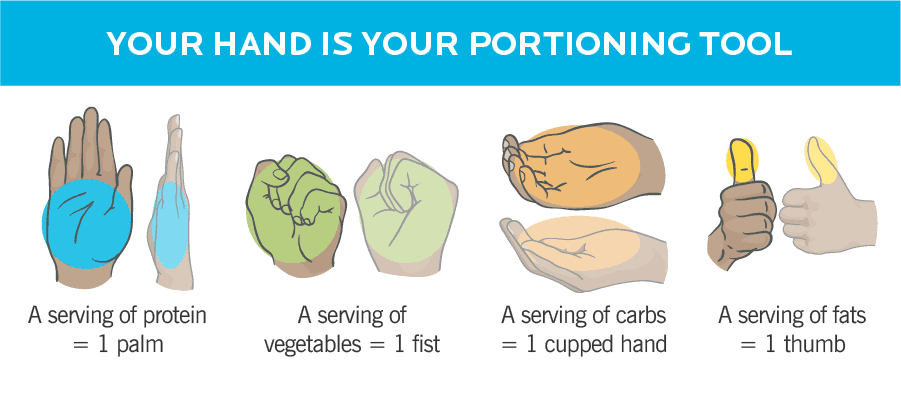
Two advantages are that your hands are always with you so you'll have a consistent reference point and your hands are proportional to your body and always the same size, serving as a reliable reference point.
To sum this up, if you are looking to lose weight and gain lean muscle, watching your macros until you get a feel for what your plate should look like, might be ideal for you. However, if you’re just strictly wanting weight loss and not to build lean muscle, watching your caloric intake and eating whole foods will get you results regardless of counting your macros according to research.
Although, macros aren't the only option - watching your plate or using your hand as your guide provides significant benefits to ensure you are hitting your macros.
To make watching your calories and macronutrient ratio easy, I use MyFitness Pal. All you have to do is download it and plug in your info such as your goals, weight, and physical activity, and the math is done for you.
Reference:
Stacks, F., Bray, G., Carey, V., Smith, S., Ryan, D., Anton, S., McManus, Kl., Champagne, C., Bishop, L., Laranjo, N., Leboff, M., Rood, J., Jonge, L., Greenway, F., Loria, C., Obarzanek., and Williamson., D (2009). Comparison of weight-loss diets with different compositions of fat, protein, and carbohydrates. N English J Med, 360(9), 859-873. DOI: 10.1056/NEJMoa0804748
Jager, R., Kerksick, C., Campbell, B., Cribb, P., Wells, S., Skwiat, T., Purpura M., Ziegenfuss, T., Ferrando., A., Shawn, A., Smith-Ryan, A., Stout., J., Arciero., P., Ormsbee, M., Taylor, L., Wilborn., C., Kalman, D., Kreider, R., Willoughby, D., Hoffman, J., Krzykowski, J., & Antonio, J. (2017). International society of sports nutrition position stand: protein and exercise. Journal Of The International Society Of Sports Nutrition, 14(20). DOI: 10.1186/s12970-017-0177-8
Kerksick, C., Arent, S., Schoenfeld, B., Stout, J., Campbell, B., Wilborn, C., Taylor, L., Kalman, D., Smith-Ryan, A., Kreider, R., Willoughby, D., Arciero, P., VanDusseldorp, T., Ormsbee, M., Wildman, R., Greenwood, M., Ziegenfuss, T., Aragon, A., & Antonio, J. (2017. International society of sports nutrition position stand: nutrient timing. Journal Of The International Society Of Sports Nutrition, 14(1), 33. DOI: 10.1186/s12970-017-0189-4